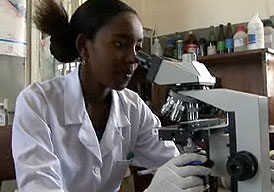
Through a landmark partnership between The Carter Center and the government of Ethiopia, the nation has created a system to help address the devastating health challenges it faces by dramatically expanding access to health care, especially in rural areas.
From 1997-2010, the Carter Center-supported Ethiopian Public Health Training Initiative worked successfully in partnership with seven Ethiopian universities and the Ethiopian government (the ministries of health and education) to address the dangerous void in rural health services for 75 million Ethiopians.
When the program began, Ethiopia had one of the lowest life expectancies in the world, and one of the highest infant mortality rates. This critical situation was compounded by the frequent migration of Ethiopia's skilled health professionals to other countries.
Today, as a result of the Carter Center-supported Ethiopia Public Health Training Initiative, more than 26,000 EPHTI-trained health service professionals serve 90 percent of the Ethiopian population.
Many health programs around the world are designed for broader regions, and then instituted in different countries with little regard for their unique cultural diversity. The underlying assumption of the Ethiopia Public Health Training Initiative was that Ethiopians fundamentally know the best way to deliver public health care to Ethiopians.
"This project has demonstrated that despite limited resources, remarkable progress can be made to improve health in Ethiopia, harnessing Ethiopian talent," said former U.S. President and Carter Center founder Jimmy Carter. "The Carter Center is proud to continue to support Ethiopia through our disease prevention programs that fight afflictions such as trachoma, river blindness, lymphatic filariasis, malaria, and Guinea worm disease, among others."
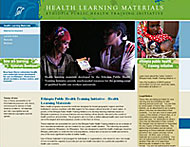 EPHTI Training Materials This site includes modules, lecture notes, and manuals developed by Ethiopians, for Ethiopians. The materials were designed to meet the country's health challenges, particularly in underserved rural populations, where lack of access to health personnel has been one of the most significant hurdles to better health.
Leveraging Ethiopian Expertise to Create Rural Health Services
International experts worked side by side with Ethiopian teaching staff at the University of Gondar, Defense College of Health Sciences, Haramaya University, Hawassa University, Mekelle University, Jimma University, and Addis Ababa University.
More than 2,500 faculty members were trained through 565 workshops and seminars. In addition, 228 learning materials were developed that reflect Ethiopian health care needs and experiences. The learning materials address life-threatening diseases and longer-term health promotion, and cover topics such as: HIV/AIDS, infectious diseases, nutrition, maternal and child health, mental health, reproductive health, and water and sanitation.
EPHTI also enhanced classroom and learning environments for health sciences students. More than 7,000 textbooks were provided as well as subscriptions to professional journals, computers, anatomical models, and supplies such as stethoscopes and gloves.
A second component of the program trained health center staff and community health workers, including traditional birth attendants and community health agents.
Providing a Road Map for Others to Follow
In 2007, the Ethiopia Public Health Training Initiative Replication Conference provided the opportunity for ministries of health, education, and science and technology from 10 African governments to learn how EPHTI's model could help address the severe shortages of health care professionals in their own nations.
Since the conference, several countries have expressed interest in establishing similar programs. Currently, lessons learned from EPHTI are being used by The Carter Center and the Liberia Ministry of Health and Social Welfare to create a national mental health system for the post-conflict nation. Read more: Replication of the Ethiopia Public Health Training Initiative >
In addition, after the 13-year partnership with The Carter Center to develop the EPHTI health learning materials, the Ethiopia ministries of health and education have made the full collection available for other countries to learn from the Ethiopian experience. These materials are online for free download here. Through a partnership with the French Ministry of Foreign Affairs, French-language translations of eight specific lecture notes and modules are available to help facilitate adoption of the training model in African Francophone countries.
Finally, in 2010, EPHTI Director Dr. Joyce Murray and Assistant Director Shelly Terrazas contributed to the new book, "Educating Health Professionals in Low-Resource Countries: A Global Approach (PDF)," (Springer Publishing Company, 2010), which provides health educators in resource-limited settings with a formal pedagogy targeted to increase the quality and numbers of health workers.
In late 2010, as part of the original agreement between the Ethiopian government and The Carter Center, the EPHTI was officially transferred to Ethiopia's Federal Ministries of Health and Education.

(Note: Scroll mouse over city name;
information will appear at bottom.)
University Partners
Learn more about the location and
work of EPHTI's university partners.
Please sign up below for important news about the work of The Carter Center and special event invitations.