Guinea Worm Disease
Since 1986, The Carter Center has led the international campaign to eradicate Guinea worm disease, working closely with ministries of health and local communities, the U.S. Centers for Disease Control and Prevention, the World Health Organization, UNICEF, and many others.
Guinea worm disease could become the second human disease in history, after smallpox, to be eradicated. It would be the first parasitic disease to be eradicated and the first disease to be eradicated without the use of a vaccine or medicine.
Considered a neglected tropical disease, Guinea worm disease (dracunculiasis) is a parasitic infection caused by the nematode roundworm parasite Dracunculus medinensis. It is contracted when people consume water from stagnant sources contaminated with Guinea worm larvae. Inside a human's abdomen, Guinea worm larvae mate and female worms mature and grow. After about a year of incubation, the female Guinea worm, one meter long, creates an agonizingly painful lesion on the skin and slowly emerges from the body. Guinea worm sufferers may try to seek relief from the burning sensation caused by the emerging worm and immerse their limbs in water sources, but this contact with water stimulates the emerging worm to release its larvae into the water and begin the cycle of infection all over again.
Guinea worm is a particularly devastating disease that incapacitates people for extended periods of time, making them unable to care for themselves, work, grow food for their families, or attend school.
In 1986, the disease afflicted an estimated 3.5 million people each year in 21 countries in Africa and Asia. Today, thanks to the work of The Carter Center and its partners — including the countries themselves — the incidence of Guinea worm has been reduced by more than 99.99% to 15 human cases in 2024.
The Carter Center works to eliminate Guinea worm in countries affected by the disease: Angola, Chad, Cameroon, Ethiopia, Mali, and South Sudan.
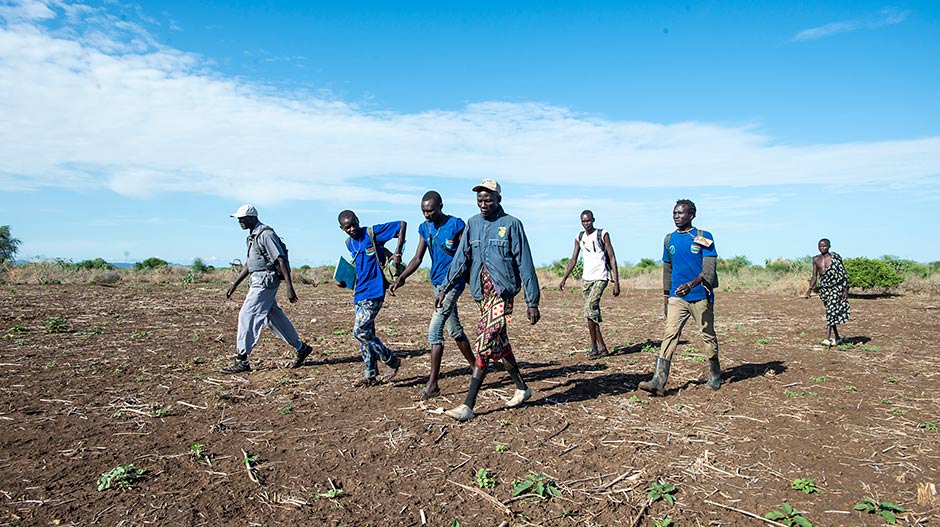
A surveillance team from the South Sudan Guinea Worm Eradication Program, led by Makoy Samuel Yibi (far left), explores an area of Eastern Equatoria state. The goal is to follow up on every reported or rumored case within 24 hours. (Photo: The Carter Center/L. Gubb)
In the six African countries, reported infections in animals declined 25%, from 887 in 2023 to 664 in 2024. Chad reduced Guinea worm infections by 43% (from 496 to 281), its fifth consecutive year of improvement. Reductions in animal infections in Chad, Angola, and Mali were partially offset by an increase in Cameroon.
There is no known curative medicine or vaccine to prevent Guinea worm disease — the same treatment for emerging worms has been used for thousands of years.
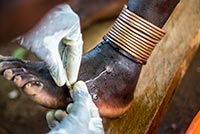
Traditional removal of a Guinea worm consists of winding the worm around a piece of gauze or small stick and manually extracting it — a slow, painful process that often takes weeks. The skin lesions often develop secondary bacterial infections, which exacerbate the suffering and prolong the period of disability.
The Center's strategy is to work with ministries of health to stop the spread of Guinea worm disease by providing health education and helping to maintain political will.
The Guinea Worm Eradication Program is wiping out this ancient disease mainly through community-based interventions to educate and change behavior, such as teaching people to filter all drinking water and preventing transmission by keeping anyone with an emerging worm from entering water sources.

A parasitologist examines a worm under a microscope in Bongor, Chad. Multiple examination methods are used to confirm specimens are Guinea worms. (Photo: The Carter Center/J. Hahn)
A challenge to eradication has been the emergence of numerous Guinea worm infections in animals, mainly domesticated dogs in Chad. Guinea worm infections were first detected in animals in 2012. Most of those infections were believed linked to dogs' consumption of fish and fish entrails containing Guinea worm larvae. Volunteers trained by Chad’s Guinea Worm Eradication Program with the Carter Center’s help have encouraged people in those areas to bury fish discards, and cash rewards are being paid for reporting infected animals and for keeping them away from water sources. Researchers are actively seeking a remedy for canine infections, including the use of established veterinary deworming drugs.
Another challenge is insecurity. Parts of some affected countries are inaccessible to the program because of internal conflict that makes these areas unsafe to enter or travel through. Guinea worm elimination cannot be confirmed until surveillance can be carried out in all areas.
For the eradication campaign to continue successfully, enormous dedication and attention to detail is critical for all field supervisors and the thousands of community-based volunteers charged with executing the campaign.
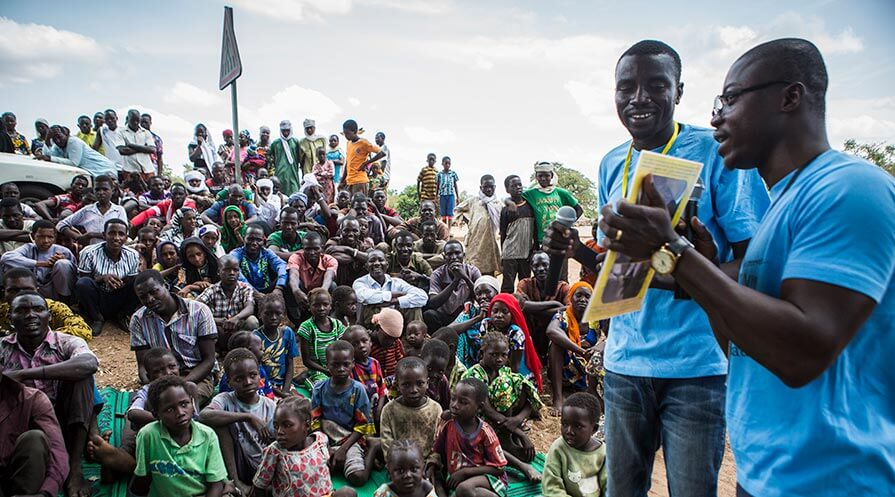
Carter Center technical advisor Laurès Dossou (foreground) and volunteer supervisor Mende Kelmane Alphonso instruct a crowd on how to detect Guinea worm disease during a cash rewards ceremony in Dangabol Village, Chad. People who report suspected Guinea worm infections and take appropriate measures can receive rewards of up to $100. (Photo: The Carter Center/ J. Hahn)
The Carter Center spearheads the international Guinea worm eradication campaign and works in close partnership with national programs, the World Health Organization, U.S. Centers for Disease Control and Prevention, UNICEF, and many other partners.
The Carter Center leads the international Guinea worm disease eradication campaign, compiles and distributes case numbers, and provides technical and financial support to national programs to interrupt Guinea worm disease transmission and bring cases to zero. When transmission is interrupted, the Center provides continued assistance in developing or strengthening surveillance in Guinea worm-free areas and preparing nations for official certification.
National Ministries of Health in the endemic countries oversee domestic Guinea worm elimination programs and engage and train field workers and supervisory staff.
The World Health Organization is responsible for certifying countries as Guinea worm-free and is the only organization that can officially certify the eradication of a disease.
The U.S. Centers for Disease Control and Prevention provides technical assistance and verifies whether worms from final patients are truly Guinea worms.
UNICEF mainly assists countries by helping to provide safe sources of drinking water to priority areas identified by the national Guinea worm eradication programs.
Learn more about where the final cases of Guinea worm disease are found »
Please sign up below for important news about the work of The Carter Center and special event invitations.
Request for Pre-proposals
The Carter Center's Guinea Worm Eradication Program is requesting pre-proposals. Read the requirements »
The Carter Center leads the international campaign to eradicate Guinea worm disease, meaning the disease will no longer exist. Guinea worm disease is poised to become the second human disease in history to be eradicated, following smallpox.




 Learn more »