Democracy
The Democracy Program works globally to support democratic elections and strengthen participatory democracy, consistent with human rights. The overarching objective is to enhance democratic governance and increase effective political participation for all, especially groups that have been historically disadvantaged or that face political, cultural, or socioeconomic barriers. This includes women, racial and ethnic minorities, indigenous persons, persons with disabilities, youth, elderly people, and other marginalized groups.
Impartial, credible election observers play a key role in shaping perceptions about the quality and legitimacy of electoral processes. Since 1989, The Carter Center has been a pioneer of election observation, forging many of the techniques now common to the field. The Center has deployed over 125 full and limited observation missions in 40 countries and three Native American nations. In addition, 18 expert missions have been conducted in 16 countries. To ensure a meaningful, nonpartisan role for its election observation activities, the Carter Center must be generally welcomed by the major political forces and/or accredited by electoral authorities.
Election observation missions start long before election day, with experts and long-term observers analyzing election laws, assessing voter education and registration, evaluating fairness in campaigns, and monitoring the impact of social media. On election day, observers assess the casting and counting of ballots. In the days and weeks after the election, observers monitor the tabulation process, electoral dispute resolution, and the publication of final results. Before, during, and after an election, the Center's findings are reported through public statements.
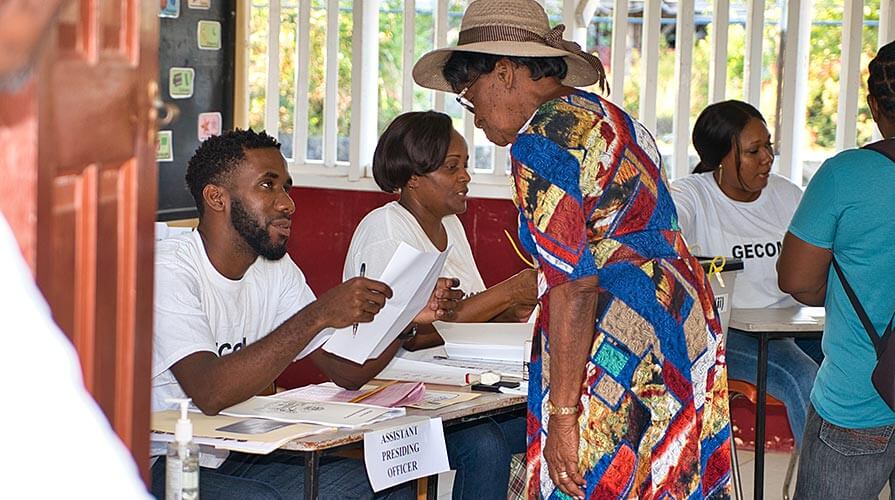
In Georgetown, the capital of Guyana, a woman checks in at her polling station for the March 2, 2020, elections. (Photo: The Carter Center/ R. Borden)
To support impartial, credible election observation, The Carter Center, in cooperation with the U.N. Electoral Assistance Division and the National Democratic Institute, played a major role in drafting the Declaration of Principles for International Observation, which established professional guidelines for election observation. The declaration has been endorsed by more than 50 organizations, which now meet annually to discuss key challenges.
Since its founding in 1982, The Carter Center has focused its efforts outside the United States. International projects continue to be central to the Center’s mission, but recently we have begun using the expertise we developed abroad to help address problems in the United States. The Center’s Democracy Program is supporting U.S. elections by bolstering democratic norms and values, increasing trust and understanding of the electoral process, and responding to the challenges posed by mis-, dis- and mal-information.
One way The Carter Center is working to increase public trust in the election process is through nonpartisan election observation. While there are some large-scale, nonpartisan election efforts in the U.S., they are largely focused on helping individuals vote and responding when rules or regulations aren’t followed.
The Center is creating networks of nonpartisan observers, composed of citizen, neighbors, and fellow voters, who will focus on ensuring that the electoral process is executed according to the law and bring attention to areas that need improvement before the next election cycle. Through nonpartisan observation, we hope to increase transparency, build public confidence by letting Americans know when elections are well-administered, and shine an unbiased light on parts of the process that fall short.
The Carter Center’s Digital Threats to Democracy Initiative develops approaches and technological tools to monitor disinformation, hate speech, harassment, coordinated inauthentic behavior, and dark advertising online.
It has recently supported digital threats monitoring activities in South Africa, Tunisia, Ethiopia, Myanmar, Bolivia, Guyana, Liberia, and Cote d’Ivoire.
The initiative equips local civic organizations with the knowledge and skills to implement social media monitoring activities, including by providing open-source technology for monitoring and developing customized machine-learning models to augment threat identification efforts, in collaboration with the Georgia Institute of Technology.
The digital threats team identifies social media activity that could suppress political participation, undermine confidence in the electoral process, or trigger hostility or violence during an electoral process. It also supports efforts to identify and mitigate abusive activity intended to attack, intimidate, or threaten individuals or groups and is currently developing a monitoring methodology and tools focusing on online gender-based violence that tries to suppress women’s participation in political life.
The initiative also monitors online political advertising to promote transparency, accountability, and a level playing field in electoral processes, analyzing political advertising regulations, social media advertising policies, and political advertising data with the aim of offering concrete recommendations for reform by lawmakers and social media platforms.
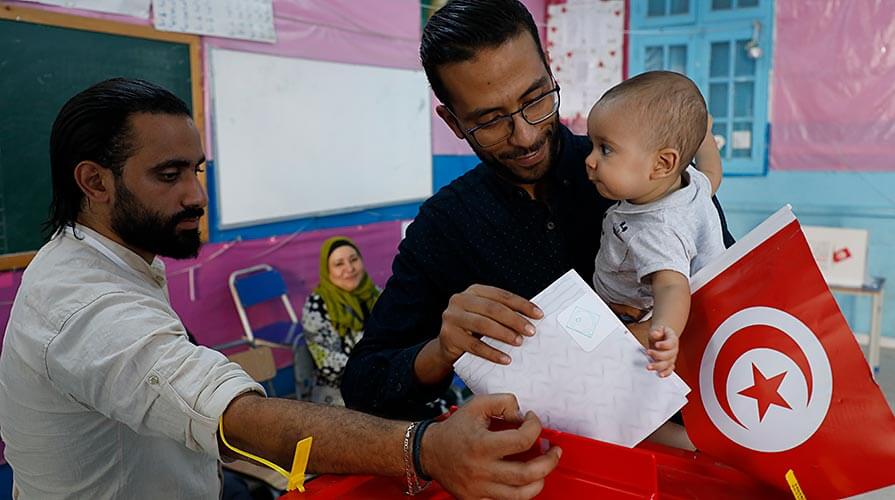
Baby in tow, a man in Tunisia's capital Tunis casts his ballot for parliamentary elections on Oct. 6, 2019. (Photo: The Carter Center/ K. Nasraoui)
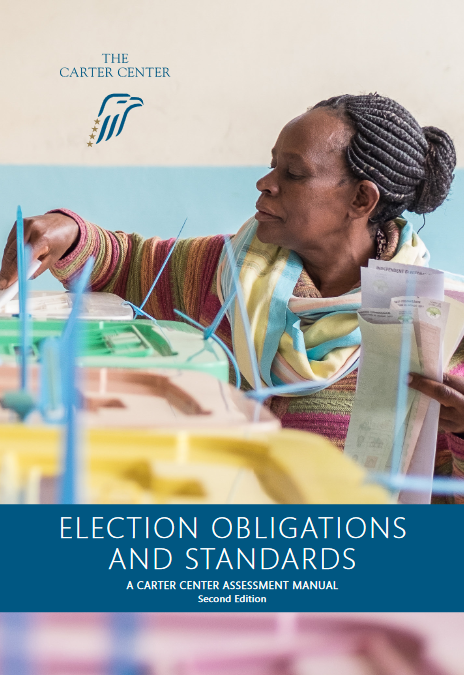
The Carter Center has played a leading role in building consensus on standards for democratic elections. In 2010, the Center launched the Election Obligations and Standards Database, which consolidates more than 300 sources of international law related to human rights and elections. It is used by The Carter Center and other election observers to assess elections against international and regional laws and standards.
As a companion to the database, The Carter Center also produced the Elections Obligations and Standards (EOS) Manual, which provides narrative descriptions and background, including an overview of the links between international obligations referenced in the database sources and specific issues that arise during various parts of the electoral process, as well as key assessment criteria. The EOS Manual aids election observers, citizens, and researchers in understanding how important obligations such as the right to vote, freedom from discrimination, and freedom of assembly apply to each phase of the process.
The Center is also one of nine organizations that together manage the ACE Electoral Knowledge Network. ACE is an online community and knowledge repository that provides comprehensive information and customized advice to electoral management bodies, political parties, civil society organizations, and researchers.
Building on its leadership in fostering consensus on standards for democratic elections, in September 2024 The Carter Center in cooperation with International IDEA, NDI, IFES, and the Kofi Annan Foundation launched the Model Commitments for Advancing Genuine and Credible Elections.
The Model Commitments outline specific steps that government leaders and democracy advocates can take to help strengthen democracy and elections, including ways to expand dialogue on key electoral issues. The Model Commitments draw on existing international norms, standards, and best practices for democratic elections, including those catalogued in the Center’s Election Obligations and Standards Database and the Election Obligations and Standards Handbook.
Between 2015 and 2017, The Carter Center and the United Nations Office of the High Commissioner for Human Rights (OHCHR) held a series of conferences and workshops with election observation and assistance practitioners and the international human rights community. Over the course of four consultations, more than 100 human rights and elections experts and representatives of states discussed the challenges facing democracy, human rights, and the rule of law in times of closing political space, and formulated clear recommendations for ways to work together to advance the common goal of genuine, democratic elections that express the will of the people.
At the final meeting, held at the Center in December 2017, the Human Rights and Election Standards Plan of Action (available in English, French, and Spanish) was prepared to synthesize all of these recommendations. The plan of action includes a series of practical suggestions on how the elections and human rights communities can work together more closely, as well as a number of longer-term recommendations.
As part of the Center’s implementation of the Plan of Action, the Democracy Program has launched the Promoting Participatory Rights project. Working at the national level in Zambia, The Carter Center seeks to engage civil society and government interlocutors to build bridges between the human rights and election communities to advance the implementation of participatory rights, with a special focus on the participation of women and youth.
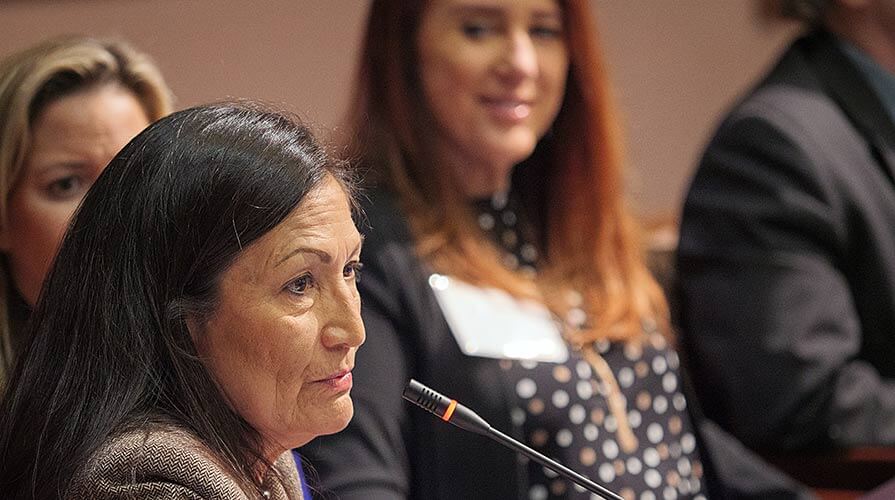
Deb Haaland, one of the first two Native American women elected to the U.S. Congress, addresses a Carter Center conference on impediments to Native American voting. (Photo: The Carter Center)
One or two democratic elections cannot change a country's political culture. Recognizing that democratic transitions are long processes, the Center works in targeted countries to strengthen the foundations of democratic governance through a range of programs: deploying international observers to monitor political transitions, constitutional drafting, and peace implementation processes; and advocating for key democratic and electoral reforms. To support these initiatives, the Center has developed a series of best-practice tools and training resources for international and domestic observers, civil society groups, and other key stakeholders.
Effective democratic government that serves its citizens is bolstered by strong nonpartisan civil society observation organizations that can strengthen the credibility of governments, promote equal political participation, expose corruption, and foster confidence in democratic processes and institutions. Because of this, the Center works in many countries, sometimes in coordination with international election observation efforts and sometimes as standalone initiatives, to provide a range of training and support to local civil society organizations that engage in these efforts.
Learn more about such work in the Democratic Republic of the Congo, Liberia, Myanmar, and Tunisia.
Please sign up below for important news about the work of The Carter Center and special event invitations.
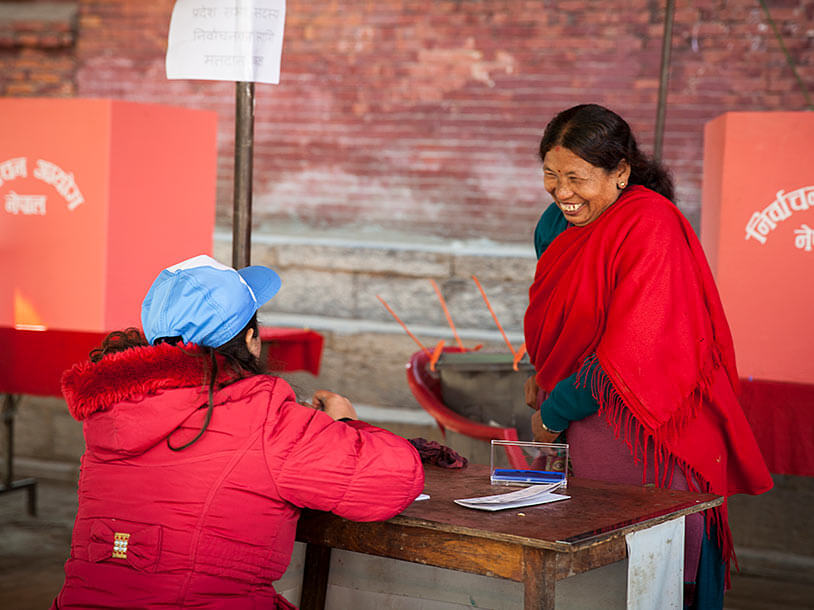 Meet people whose lives have been changed by the Carter Center's Democracy Program.
The Carter Center provides an impartial assessment of electoral processes and, where relevant, recommends improvements. Read the reports.