Disease Eradication
Inspired by the successful eradication of smallpox in 1977, the International Task Force for Disease Eradication formed at The Carter Center in 1988 to evaluate disease control and prevention and the potential for eradicating other infectious diseases.
Scientists and notable international health organizations serving on the task force have identified eight diseases that potentially could be eradicated, thereby dramatically and permanently improving the quality of life for many millions of the world's poorest people.
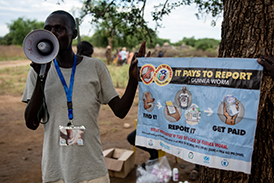
Those diseases are: Guinea worm (dracunculiasis), poliomyelitis, mumps, rubella, lymphatic filariasis, cysticercosis, measles, and yaws.
Currently supported by the Bill & Melinda Gates Foundation, the task force reviews progress in the field of disease eradication and the status of diseases selected for control or eradication, and recommends action steps.
In addition to sponsoring and hosting ITFDE meetings, Carter Center health programs address two of the diseases currently identified by the ITFDE for eradication (dracunculiasis and lymphatic filariasis) and three diseases identified for elimination or better control (onchocerciasis, also known as river blindness, trachoma, and schistosomiasis).
In 2006, the ITFDE determined that malaria and lymphatic filariasis could be eliminated from the Dominican Republic and Haiti, which share the island of Hispaniola. Since then, the Carter Center’s Hispaniola Initiative has made great strides in promoting binational cooperation to eliminate these two diseases on the island.
Scientific feasibility and political support are the two primary factors determining whether a disease can be eradicated.
Conditions that make it scientifically feasible to eradicate a disease include:
Even if it is scientifically feasible to eradicate a disease, there are nonscientific conditions that must be considered, such as:
Please sign up below for important news about the work of The Carter Center and special event invitations.
"The potential for disease eradication to permanently improve quality of life worldwide is tremendous."
– Dr. Donald Hopkins
Special Advisor for Guinea Worm Eradication, Carter Center Health Programs