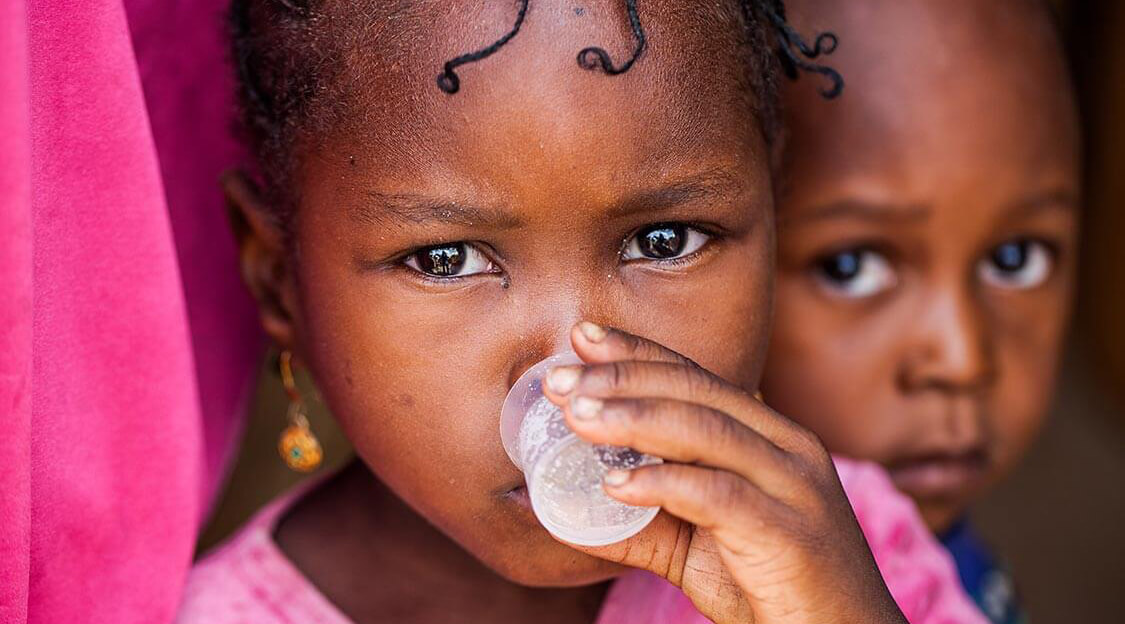
A girl in Bossadje, Niger, drinks from a dosing cup as part of an international study that has shown a link between azithromycin and reductions in child mortality. (Photo: Gates Archive/Dominique Catton)
Kelly Callahan, M.P.H.
Director, Trachoma Control Program
Kelly Callahan has more than 25 years of experience in neglected tropical disease control, elimination, and eradication. As director of the Carter Center’s Trachoma Control Program, she oversees programmatic, technical, and financial support for implementation of the SAFE strategy for trachoma elimination in five countries. She also supports operational research toward meeting trachoma elimination thresholds and coordinates and collaborates with other neglected tropical disease programs at the Center and many other organizations.
Callahan started her public health career in 1996 as a United States Peace Corps volunteer based in the Ivory Coast. She joined The Carter Center in 1998, working in southern Sudan, where she was the field coordinator and then country director for the Sudan Guinea Worm Eradication Program (SGWEP). She has held a variety of positions at The Carter Center and lived in Africa for almost 10 years. In 2017, the National Peace Corps Association gave her its annual Sargent Shriver Award for Distinguished Humanitarian Service.
Callahan holds a master’s degree in public health from Emory University and an undergraduate degree in earth sciences and communications from the University of Cincinnati. She has contributed over 50 peer-reviewed publications to leading scientific journals.
Scott Nash, Ph.D.
Epidemiologist, Trachoma Control Program
Scott Nash provides technical and scientific support to the Center's Trachoma Control Program. Nash conducts impact surveys, monitors and evaluates program activities, and develops measurable indicators for field research.
Prior to joining The Carter Center, Nash served as a postdoctoral research fellow at the National Institutes of Health. His epidemiological experience includes global health research in sub-Saharan Africa, including a study on the role of environmental factors on the presence of blinding trachoma in Tanzania. Nash also served as an HIV/AIDS and biology educator with the U.S. Peace Corps volunteer for two years in rural Tanzania.
Nash earned both a master of science and doctorate in population health sciences from the University of Wisconsin-Madison, where he was the lead epidemiologist for quality control and assurance for two large observational studies of the aging senses. He also holds a bachelor of science in education and zoology from the University of Wisconsin-Madison.
Angelia Sanders, DrPH, M.P.H., M.A.
Associate Director, Trachoma Control Program
Angelia Sanders assists the national trachoma control programs supported by The Carter Center by writing grant proposals and reports; monitoring program activities and spending; and providing technical assistance to ministry of health and Carter Center field staff.
Sanders has an extensive background working in public health with a focus on program delivery in resource-poor communities. She previously worked for The Carter Center in South Sudan, serving as a regional coordinator in the Guinea Worm Eradication Program before becoming a technical advisor in the Trachoma Control Program. In 2019 she was named vice chair of the International Coalition for Trachoma Control.
Sanders also brings experience from serving in Kenya with the United States Peace Corps, the NATO Civil-Military Fusion Center, and the University of South Florida Global Center for Disaster Management and Humanitarian Assistance. She holds Doctor of Public Health and Master of Public Health degrees from the University of South Florida, where she also received a graduate certificate in humanitarian assistance; a Master of Arts in international studies from Old Dominion University; and a Bachelor of Science in government administration from Christopher Newport University.
Kim Jensen, M.P.H.
Associate Director, Trachoma Control Program
Kim Jensen assists the national trachoma control programs of the ministries of health in Ethiopia, Mali, and Niger. This support includes writing grant proposals and donor reports; monitoring program activities and outputs; developing and tracking program budgets; and providing technical guidance to the Carter Center country teams and ministries of health.
Jensen has an extensive background in trachoma and Guinea worm disease. As a graduate student at the Rollins School of Public Health at Emory University, Jensen was a graduate assistant with The Carter Center and supported an assessment of the health education curriculum in Amhara, Ethiopia. After that first stint at The Carter Center, Jensen worked for other partners working on trachoma elimination, including the International Trachoma Initiative (ITI) and Sightsavers. She also served as a technical advisor for the Guinea Worm Eradication program in Ethiopia. Jensen holds a dual Bachelor of Arts degree in journalism and mass communication and Spanish from the University of Wisconsin-Madison, a Master of Arts in Spanish language teacher education from Universidad de Alcalá, and a Master of Public Health degree from the Rollins School of Public Health at Emory University.
Tania Gonzalez, MAS
Data Analyst
Tania Gonzalez provides data expertise and technical support for the Trachoma Control Program. She develops disease monitoring dashboards, performs scientific analyses for journal publications, automates geospatial analyses, and translates data insights key to the elimination of trachoma. Gonzalez brings a background in public health, environmental science, data science, and spatial analytics. She previously worked with the GIS department at the City of Atlanta Office of City Planning, where she created dashboards, web apps, and other data visualizations across multiple departments. In addition, she has served The Carter Center as a graduate assistant. Gonzalez earned her Bachelor of Public Health degree at Kent State University and Master of Applied Science in Spatial Analysis from the Johns Hopkins University Bloomberg School of Public Health.
Nico Presley, M.S.
Research Coordinator
Nicholas “Nico” Presley is responsible for overseeing the coordination, management, and conduct of the Trachoma Control Program’s operational research portfolio.
Before joining The Carter Center, Presley supported the Ministry of Health of Panamá in the design, implementation, and supervision of case management interventions for malaria elimination in the role of senior associate for the Clinton Health Access Initiative. He also worked as a Peace Corps volunteer in Panamá, where he focused on improving access to water in an indigenous Emberá community, as well as supporting the development of local water committees through community mobilization.
Presley graduated with a Bachelor of Science degree in biology with a minor in Spanish from Truman State University and holds a Master of Science degree with distinction in the control of infectious diseases from the London School of Hygiene and Tropical Medicine.
Sara Wom, M.P.H.
Program Associate
Sara Wom coordinates grant reports, proposal writing, preparation of budgets, and supporting operational research and partnerships. She also maintains the Trachoma Control Program’s treatment data, prepares graphics and presentations, and fulfills other responsibilities. She joined the Carter Center in 2020 as a program assistant with Special Health Projects. Wom was born in Khartoum, Sudan, and lived in Cairo, Egypt, briefly prior to immigrating to the United States with her family. She received her B.A. in international studies with a focus in development and a minor in Arabic from the University of Iowa. She earned her Master of Public Health degree and a certificate in health promotion and education from Benedictine University.
Laurie Baxley
Program Assistant, Trachoma Control Program
Laurie Baxley assists the rest of the Trachoma Control Program staff by arranging travel, organizing meetings, planning the calendar, and providing other office support. She also helps plan and coordinate the annual trachoma program review in Atlanta. Before joining The Carter Center staff full time, Baxley was a temporary administrative assistant in Health Program Support and a logistical coordinator for Carter Center health programs. She also owned a photography business.
Please sign up below for important news about the work of The Carter Center and special event invitations.